The missing stone beneath the city
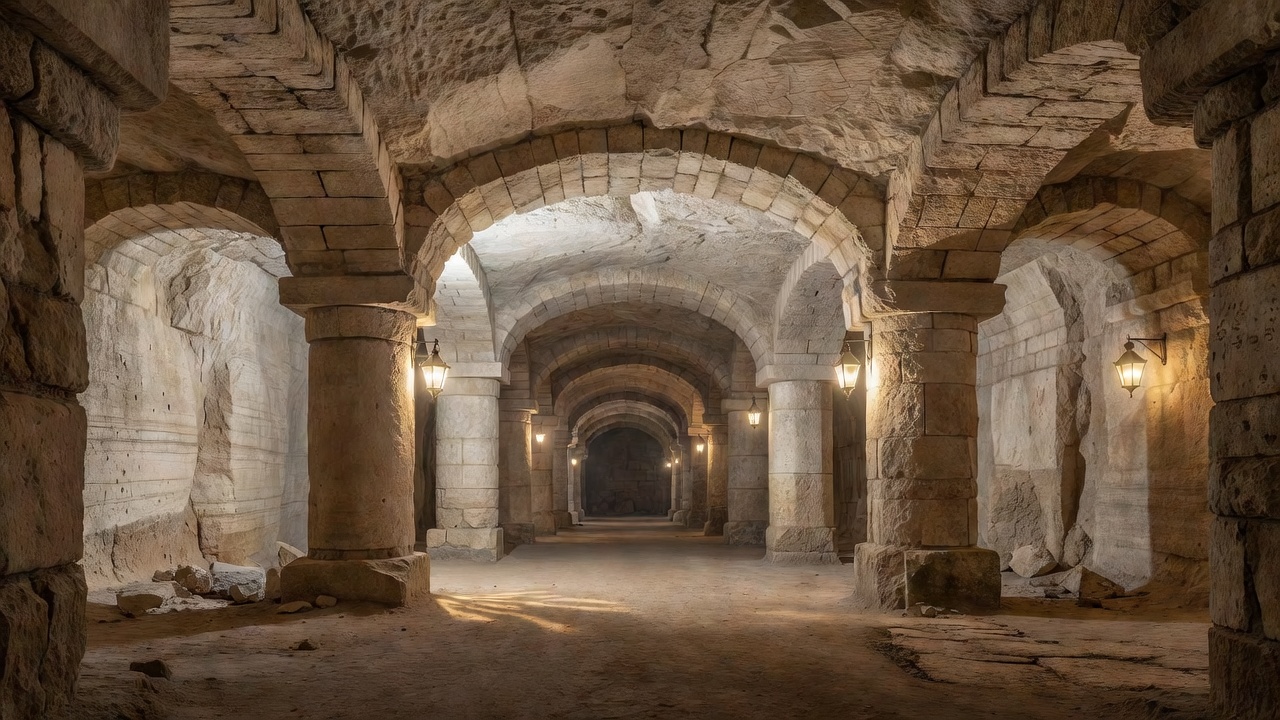
Paris’s underground history begins with a material relationship. Limestone extracted from beneath and around the growing city became part of the architecture above. Quarrying left workings that later urban expansion could conceal from everyday view. These spaces were not originally excavated to create a mysterious parallel city; they were workplaces shaped by the removal of useful stone.
The distinction matters when looking at a passage. A rough face, a support pillar and a neatly finished wall may belong to different operations. Some features relate to extraction, while others reflect later consolidation or the organisation of a managed route. Underground surfaces can therefore tell a history of labour followed by a history of maintenance, rather than one uninterrupted phase of construction.
Making uncertain ground legible
As Paris expanded, old workings became an engineering concern. The Inspection générale des carrières, established in 1777, developed a sustained programme of investigation and consolidation. Surveying and support work helped authorities understand what lay beneath streets and buildings. The inscriptions and masonry associated with this work are records of administration as well as physical safeguards.
It is tempting to imagine every gallery as ancient and untouched. In reality, underground landscapes are repeatedly modified. Repairs, blocked connections and modern visitor arrangements can shape what is visible today. Ask what you are looking at before assigning it to the quarry’s earliest phase. A modest support wall may reveal more about the survival of the city above than a dramatic stretch of bare rock.
Stone is removed for construction.
Survey and support work address unstable ground.
Selected workings become a municipal ossuary.
Why human remains came here
The Paris Catacombs are a municipal ossuary occupying part of former quarry workings. Transfers from overcrowded burial grounds began in the late eighteenth century, including remains from the cemetery of Les Innocents. This was an administrative response to problems at the surface, not evidence that the entire quarry network had been designed as a burial complex.
The name “Catacombs” can encourage comparison with ancient burial galleries elsewhere, but the Paris site has its own development. The arrangement of bones and the placement of inscriptions also reflect later presentation. Héricart de Thury, associated with the early nineteenth-century organisation of the ossuary, forms part of this interpretive history. What visitors see is both a resting place and a deliberately structured encounter with mortality.
A visit with ethical weight
Human remains are not props. Keep your hands away from the displays, do not cross barriers and follow current photography rules. Quiet conduct is appropriate even when a group’s interpretation feels theatrical. The people represented here had individual lives, although most cannot be identified by a visitor. Respect does not require inventing stories about them; it begins by acknowledging that limit.
Some travellers find the ossuary emotionally difficult for reasons unrelated to narrow spaces. Images of arranged bones can understate the effect of standing among them. If bereavement, religious concerns or personal discomfort make the experience unsuitable, choosing not to enter is entirely reasonable. You can understand Paris’s relationship with extraction and urban infrastructure without visiting human remains.
Public route, restricted network
The official visitor site near Denfert-Rochereau provides a defined route through only a small part of the underground landscape. It does not grant permission to explore the wider former quarry network. Restricted areas can present legal, structural and navigation hazards. We do not publish unofficial access points, entry methods or directions through closed galleries.
Check the official Catacombs website for the current opening situation, admission arrangements, bag restrictions and route requirements. Do not rely on an old travel article for live operational information. If a site is temporarily closed, an unofficial alternative is not a responsible substitute. The same principle applies to any tour claiming access beyond normal public arrangements: verify the operator’s authority rather than accepting a dramatic description.
Plan for the whole route
Underground accessibility involves getting back to the surface as well as descending. Ask about stairs, handrails, rest opportunities and whether an early exit is possible. Temperature, dampness and uneven surfaces can affect comfort, while the enclosed route may feel longer than its distance suggests. Anyone with a relevant health concern should seek individual advice and the operator’s factual access information before booking.
The most revealing visit keeps three histories in view: the workers who removed the stone, the engineers who supported the ground and the authorities who relocated the dead. Together they show a city negotiating the consequences of its own growth. Paris below ground is not separate from Paris above; it is one of the clearest records of how that city was made.