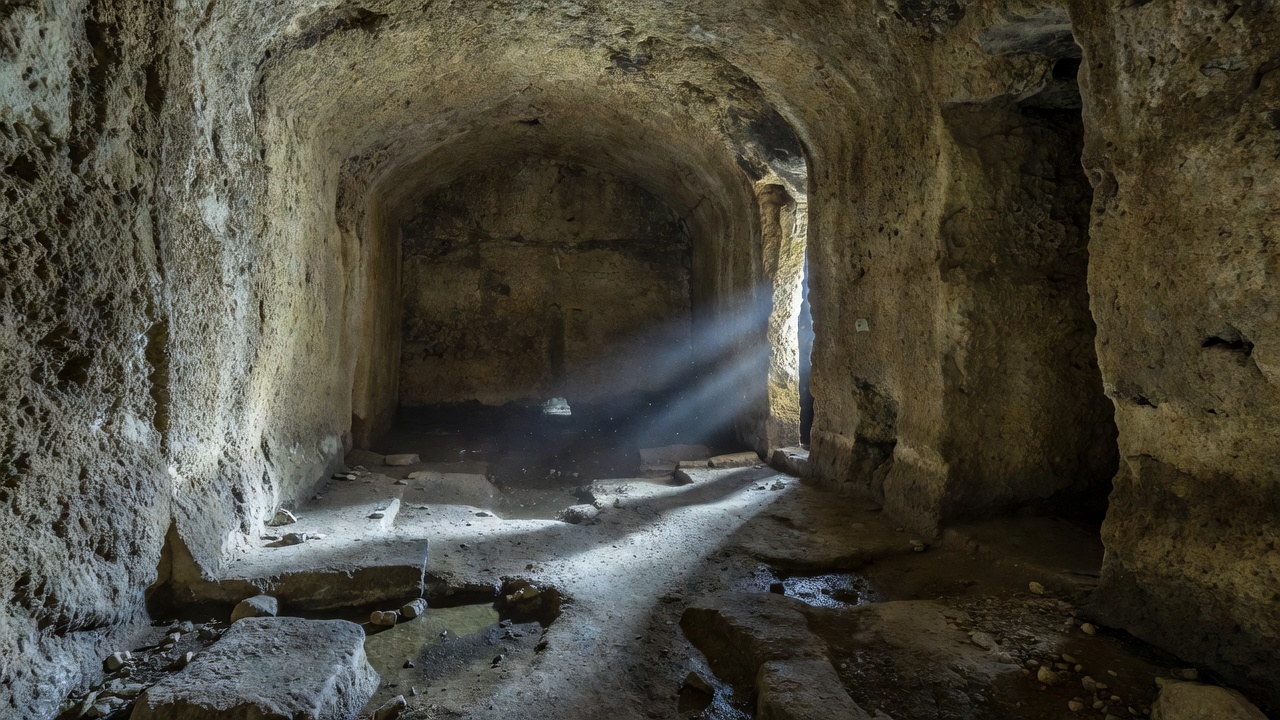
A city shaped by what was removed
Naples makes the relationship between excavation and urban growth unusually tangible. Beneath the dense streets, volcanic tuff was cut for construction, leaving cavities that could be enlarged, connected or adapted. The result is not one uninterrupted subterranean city with a single entrance. It is a collection of spaces with different histories, owners, management arrangements and degrees of public access.
Greek and Roman Naples form part of the long background to this underground landscape, but the layers do not line up neatly. Later builders reused earlier openings, and modern routes select particular parts of a much larger physical and historical picture. When a guide identifies a quarry face or a water channel, ask what distinguishes that feature from the modifications around it. The answer is often more interesting than a simple claim of great age.
From building material to water storage
A quarry void becomes useful in a new way when it can hold or distribute water. Cisterns and aqueduct-related spaces reveal how the underground supported everyday life above. Look for changes in wall treatment, the relationship between high openings and chamber floors, and the way adjoining spaces connect. Large volume alone is not proof that a chamber began as a purpose-built reservoir.
Napoli Sotterranea is a well-known public attraction associated with this story of excavation and water infrastructure. The Lapis Museum at the Pietrasanta complex presents another encounter with underground Naples. These names should not be treated as interchangeable booking labels. Their routes, interpretation and access conditions differ, and a photograph from one attraction does not reliably describe what you will encounter at another.
Extraction supplies material for the city above.
Selected voids become infrastructure.
Existing spaces acquire emergency uses.
A royal project with later lives
The Galleria Borbonica introduces a different strand. Begun in the nineteenth century under Ferdinand II, the Bourbon tunnel project was connected with royal and military concerns. Its later uses, including wartime shelter and the storage of vehicles, complicate any idea that underground spaces keep the purpose for which they were first designed. Objects encountered on a tour may belong to a much later chapter than the surrounding excavation.
During the Second World War, parts of underground Naples sheltered civilians from air raids. This phase deserves more than a dramatic pause in a tour narrative. Consider the practical conditions: shared space, access to water, sanitation, time spent waiting and the uncertainty of returning above ground. Graffiti and surviving fittings can make that experience immediate, but individual stories should be distinguished from broader claims about every chamber.
Different underground histories nearby
The Catacombs of San Gennaro and San Gaudioso belong to the city’s funerary and religious history, not simply to the same quarry-and-cistern itinerary. They are managed visitor sites with their own interpretation and rules. Including one in a trip can broaden your understanding of Naples, provided you resist treating all subterranean architecture as a single category of attraction.
Likewise, an ancient remnant beneath a building is not evidence that an entire surrounding network is open for exploration. Historic cities contain private basements, service infrastructure, unstable voids and archaeological areas under protection. Use official public tours and follow the precise route offered. We do not provide access instructions for closed cavities, service openings or unregulated passages.
Choose with your body in mind
Ask the operator to describe the route in ordinary physical terms. How many stairs are involved? Are there wet surfaces? Must visitors turn sideways, bend repeatedly or pass through a section with limited lighting? If a narrow section is described as optional, confirm where you wait and whether skipping it changes the exit arrangement. Accessibility can vary even between tours run by the same organisation.
Wear stable shoes and bring only permitted bags. Underground temperatures and humidity may feel different from the street, but do not assume a particular temperature or dryness without checking. If enclosed spaces cause anxiety, request a factual route description rather than reassurance that “everyone manages.” A short visit to a suitable route is a better choice than an ambitious descent that leaves you distressed.
Read the layers without disturbing them
Stay away from barriers, avoid touching wall deposits and follow instructions around water. Do not move objects to improve a photograph. At shelter sites, abandoned-looking materials may form part of the historical display or surviving context. The strongest memory of underground Naples may be a change in scale: an ordinary street overhead, an unexpected chamber below, and the recognition that people repeatedly made new uses for what earlier generations left behind.